
Managing late drilled winter cereal crops has become a key topic in recent seasons due to the trend towards wet autumns and challenging establishment conditions. Therefore, crops enter the spring behind where they should ideally be in terms of NDVI and biomass for maximum yield. Building biomass during the spring is crucial to higher yields. By boosting both above and below ground biomass and retaining tillers early season helps push the photosynthetic potential of the crop. Making the right agronomy decision at the critical foundation and construction stages of crop development can help reduce variation in yield year on year.

In the UK, due to a record-breaking wet September most winter wheat crops were planted in October and November. Recent wet conditions have brought early crop nutrition into sharp focus, as areas that have received above average rainfall has seen soils depleted of any residual nitrogen. If there is plenty of moisture, there is also the potential issue of ‘lazy rooting’ in the autumn. This can often lead to yield losses if the weather in the spring turns dry, as root biomass is low and root depth is shallow. The situation is similar in other European countries, including France, Germany and Eastern Europe.
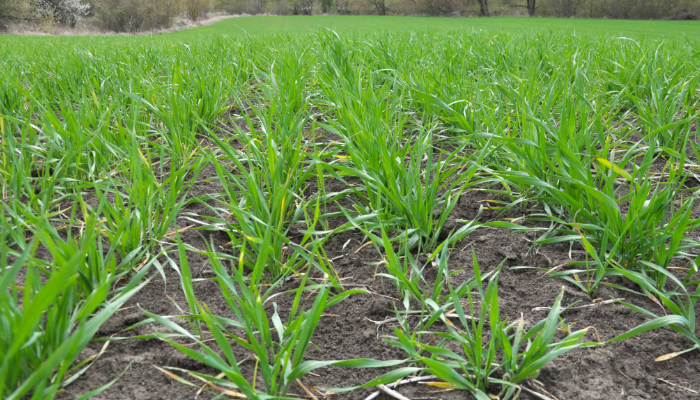
With crops still in the foundation stage, the benchmark for optimum yield is 1020 shoots/m2. This is heavily influenced by variety, sowing date, plant population and nitrogen supply. During the foundation stage root growth is slow but there is a small window of opportunity to manipulate rooting prior to GS31, when the benchmark reaches 15 km roots/m2. Rooting is impacted by soil type, structure, sowing date, temperature, and disease. Deep rooting significantly improves soil water supply to the crop with higher root length densities required to take up less mobile nutrients e.g. phosphorus.

Beginning a biostimulant programme in the early growth stages of the crop is of particular importance in late drilled crops as the foundation phase and rooting window is shortened. Status contains MTU® which has a unique mode of action that increases the chlorophyll content in the photosystem. Therefore, it boosts photosynthetic efficiency, increasing the production of energy and sugar which leads to faster growth of roots and shoots. A healthy plant is fundamental before we consider anything else and invest in further crop protection inputs.
It’s possible to promote rooting development using Status® (a novel new pure plant biostimulant made up of MTU® + pidolic acid). However, there is a narrow window to improve and influence root depth before stem extension (GS31).
The BBCH 27 – 30 timing is critical in terms of biostimulant application as it is early enough to still influence rooting, tiller numbers and tiller survival. Applied at T0, biostimulant technologies stimulate the growth of the root system, increase nutrient uptake, and improve green leaf retention.
With several vital nutrients lacking, winter planted crops will be struggling to find enough to aid growth.
The following activities could therefore be worthwhile:
Don’t forget the importance of micronutrition and trace elements to help speed up crop recovery and boost biomass too. Manganese (Mn), copper (Cu) and zinc (Zn) all contribute to protein synthesis in the plant, required for tiller production and maximising photosynthesis for the maintenance of healthy green leaves. The table below outlines the main benefits of these nutrients:
| Micronutrient | Use in the plant |
|---|---|
| Manganese (Mn) | Involved in photosynthesis (PSII), SOD superoxide detox and nitrate reduction pathways in the plant, protein synthesis. |
| Copper (Cu) | Involved in photosynthesis, required for the manufacture of lignin. |
| Zinc (Zn) | Important in the synthesis of proteins and nucleic acid, used in the metabolism of carbohydrates and the Auxin. |
Cearum is a foliar nutrient containing Mn, Zn and Cu, plus the R100® biostimulant which significantly increases the uptake of these three compounds when applied to winter cereals. The combination of sulphate and nitrate forms of manganese gives both fast uptake and persistence. R100® will also increase the amount of cytokinins in plant tissue, which stimulate cell division and plant growth.
Wet autumns and difficult establishment conditions in recent seasons have pushed drilling dates later. This often leaves crops entering spring with reduced NDVI and biomass, making yield recovery a key challenge.
In the UK, record rainfall in September meant most winter wheat was drilled in October–November. Heavy winter rain has depleted residual nitrogen and, in some cases, led to ‘lazy rooting’ (shallow, low biomass root systems that are vulnerable if spring turns dry). Similar patterns are being seen in France, Germany, and Eastern Europe.
At the foundation stage, aim for around 1020 shoots/m² for optimum yield potential. By GS31, a root length density of 15 km/m² is the target. Deep, well-developed roots are essential for accessing water and less mobile nutrients such as phosphorus.
Both above and below-ground biomass drive photosynthetic potential and nutrient uptake, which is vital for tiller survival. Maximising biomass early in spring helps reduce yield variation and supports more consistent harvest performance.
Late drilling shortens the foundation and rooting phases. Biostimulants like Status® (MTU® + pidolic acid) stimulate root and shoot growth, boost chlorophyll content and improve photosynthetic efficiency, helping plants ‘catch up’ before stem extension.
The BBCH 27–30 timing (before GS31) is critical. Applied at T0, biostimulants can still influence root depth, tiller numbers and tiller survival. This window closes quickly, so early-season applications are key.
Cearum delivers Mn, Zn, and Cu. It contains R100®, which boosts uptake of these nutrients and increases cytokinin production for stronger growth. Its dual sulphate/nitrate manganese formulation ensures fast uptake and persistence.
Make the right agronomic decisions early in spring. Get the basics right, address nutrition gaps, and apply targeted biostimulant programmes to accelerate growth and recovery before critical growth stages.

‘Science led, Agronomy driven’ are registered trademarks of IntraCrop Ltd.
All trademarks acknowledged
©IntraCrop 2026

