
Sulphur Maxx: improving sulphur uptake and stress resilience
Sulphur is an essential macronutrient, playing a central role in the formation of proteins, amino acids and enzymes which are critical for plant metabolism and growth. Deficiencies can restrict yield, reduce nutrient use efficiency (NUE) and ultimate limit crop resilience even when nitrogen supply is adequate.
Sulphur Maxx has been developed to address not just sulphur supply, but how efficiently sulphur and other nutrients are taken up and utilised by the plant.
The key technology in Sulphur Maxx is dimethyl sulphone, a unique molecule that improves nutrient uptake by increasing the permeability of the plant cuticle and cell walls. By enhancing membrane permeability, it facilitates more efficient movement of foliar-applied nutrients into internal plant structures. This improves the uptake of sulphur and supports the transport and assimilation of other nutrients, particularly nitrogen, delivering a measurable improvement in NUE.
As opposed to simply increasing nutrient dose, this mechanism allows lower application rates to achieve higher internal nutrient concentrations, improving crop safety and reducing the risk of scorch or antagonism.
Controlled glasshouse trials conducted at the University of Nottingham demonstrated a clear dimethyl sulphone dose response in both winter wheat (cv. Siskin) and oilseed rape (cv. Aspire).
Across both crops:
- Dimethyl sulphone at 50–100 g/ha significantly increased sulphur uptake
- ATS applied at 5 L/ha (without DMS) resulted in similar crop sulphur content to 2.5 L/ha ATS combined with DMS at 100 g/ha. (Figure 1)This confirms that uptake efficiency, not total applied sulphur, is the key limiting factor
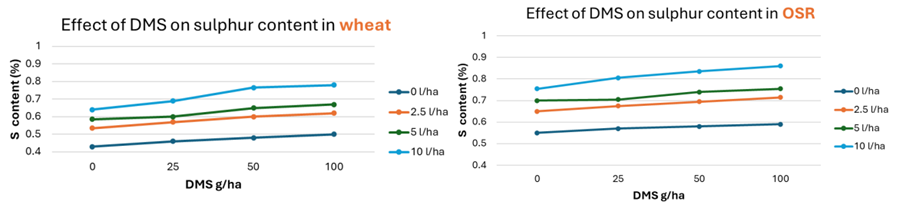
These results highlight how Sulphur Maxx improves NUE by enhancing nutrient uptake rather than relying on higher fertiliser inputs.
Abiotic stresses such as drought limit nutrient mobility and uptake, compounding the effects of deficiency. By improving nutrient delivery to plant tissues, dimethyl sulphone supports metabolic activity under stress and helps maintain growth when conditions are limiting.
Dimethyl sulphone exhibits antioxidant and cryoprotective effects, which can help protect plant cells under conditions of abiotic stress, such as drought, cold, and salinity. It has the ability to scavenge reactive oxygen species and stabilise cellular membranes. Dimethyl sulphone is used to reduce oxidative damage in crops under extreme environmental conditions.
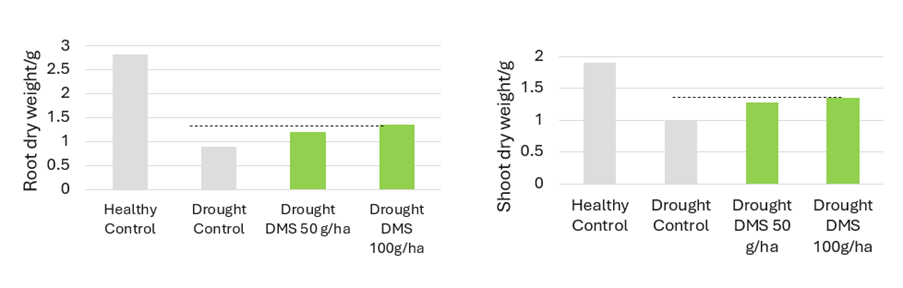
GEP registration trials (Figure 2) in winter wheat, conducted by the University of Nottingham, have shown that Sulphur Maxx supports crop performance under drought stress, with treated plants showing improved resilience compared with untreated controls.
Recommendations
Typical dose rate: 3 L/ha
DMS content: 72.6 g/ha at standard rate
Function: Improves sulphur uptake, enhances NUE, supports stress tolerance and improves crop safety
Sulphur Maxx is designed for use within standard foliar nutrition programmes and can be positioned to support crops during periods of high nutrient demand or environmental stress.

