
More resilient sugar beet crops in unpredictable seasons
Sugar beet growers continue to face increasingly complex challenges. This includes managing drought, but has also been impacted by variable spring establishment, periods of heat stress, fluctuating rainfall patterns and pressure on nitrogen efficiency.
While sugar beet remains relatively resilient compared with many other arable crops, periods of stress during canopy development and root filling can significantly reduce yield potential and sugar production. Recent research highlights that stress occurring during key growth stages can accelerate leaf senescence, reduce photosynthesis and limit root development. As a result, improving crop resilience is becoming an important part of sugar beet management.
Previous seasons have highlighted how rapidly growing conditions can change in sugar beet. Early-season drought, elevated temperatures and periods of high light intensity place significant pressure on crops across many sugar beet-growing regions.
When these plants experience stress, photosynthetic efficiency declines, oxidative damage increases and plants often begin to senesce earlier than wanted. This reduces the crop’s ability to continue producing and storing sugars within the root, reducing their value at harvest. Maintaining green leaf area and protecting photosynthesis during periods of stress can therefore have a significant influence on final yield and crop quality.
Status® combines two complementary biostimulant technologies: MTU®, a patented single molecule; and pidolic acid, which supports nitrogen assimilation.
MTU® helps protect the photosynthetic apparatus of crops during periods of abiotic stress, including drought and heat Research has shown that it supports Photosystem I activity and helps maintain cyclic electron flow, reducing oxidative stress damage within a wide variety of plants.
Pidolic acid supports nitrogen assimilation and amino acid production, limiting the build-up of toxic ammonia during stress. Together, these technologies support crop resilience while improving nutrient use efficiency.
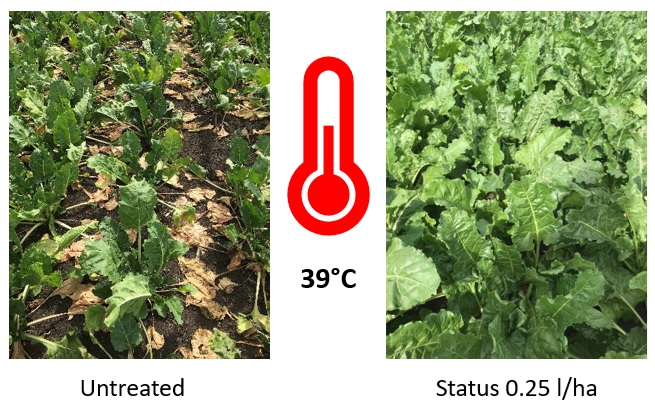
Status was applied to sugar beet in Cambridge, UK. These images were captured just 5 days after a 0.25l/ha application of Status, following 2 days of extreme conditions reaching 39°C.
In stressed conditions, plants produce increased levels of reactive oxygen species, which can damage chlorophyll and reduce photosynthetic efficiency. By protecting the photosynthetic machinery and supporting energy production, Status® helps crops maintain physiological activity for longer.
This can result in improved green leaf retention and greater stress tolerance. Quicker recovery following adverse conditions allows for a protection of yield and ROI. The objective is not simply to respond to stress after it occurs, but to build greater resilience before periods of environmental pressure develop.
Previous work in sugar beet has shown encouraging responses following applications of Status® during early crop development.
Replicated and commercial-scale observations have shown improvements in crop growth, canopy retention and yield potential, particularly where crops have experienced periods of drought or heat stress. Earlier work demonstrated significant yield advantages under severe drought conditions, while more recent tramline work has continued to show positive responses under more variable growing seasons.
Application timing remains important, with treatments typically targeted during the six to eight true leaf stage when crops are establishing canopy and root systems. However, yield responses have also been significant when applied with the 1st fungicide when canopy cover is established.
As environmental conditions become increasingly unpredictable, growers are seeking tools that help crops maintain performance during periods of stress. Alongside variety selection, soil health, nutrition and water management, biostimulants are becoming an important component of integrated crop resilience strategies.
IntraCrop is also currently involved in collaborative research projects investigating how advanced technologies such as hyperspectral imaging and remote sensing may help improve our understanding of crop responses to biostimulants and plant stress.
As new data and technologies emerge, improving resilience rather than simply reacting to stress is likely to become an increasingly important focus for sugar beet production.
Practical guidance
- Apply Status® at 0.25 l/ha.
- Target applications at BBCH 16–18 (six to eight true leaves) or combine with the 1st fungicide application
- Consider applications ahead of forecast stress periods where possible.
- Integrate with wider crop management strategies including nutrition, soil health and variety choice.

