
Maximising NUE in a challenging fertiliser market with Nutrino Pro
The fertiliser market continues to present significant challenges for UK growers. Volatility in nitrogen prices and ongoing supply chain pressures are causing real concern, particularly given they are paired with increasing drive to replace some traditional fertiliser inputs to decarbonise the food supply chain. Improved nutrient use efficiency is quickly becoming the focus on how inputs are managed across cropping systems, both for economic and environmental reasons. This means that for many growers, the focus is no longer on how much fertiliser is applied, but how effectively it is utilised by the crop.
Biostimulant technologies that improve nutrient uptake and efficiency are becoming increasingly important, particularly in high-value and high-demand crops such as oilseed rape, maize and winter cereals.
Even where fertiliser is applied at optimal rates, uptake is often restricted by soil moisture variability, temperature fluctuations, compromised rooting and periods of stress during key growth stages. As a result, a proportion of applied nutrients may remain unavailable to the crop, reducing overall efficiency and ROI. For example, grain analysis conducted by Frontier Agriculture in the UK after harvest 2024 indicated on average the NUE for feed wheat was 60-70%. Indicating 30-40% is lost via leaching, volatilisation or simply not assimilated by the plant.
Nutrino Pro has been developed to support this change of focus, offering a targeted foliar nutrition approach designed to enhance nutrient use efficiency and support crop performance even under variable conditions. It is a foliar-applied nutritional technology designed to complement traditional fertiliser programmes by improving how crops access and utilise nutrients.
Its role within a crop management programme is to:
- enhance nutrient uptake and assimilation
- support metabolic activity within the plant
- improve efficiency of applied fertilisers
- maintain performance under suboptimal growing conditions
By working through the plant when crop biomass is high rather than direct soil applications, Nutrino Pro helps bypass some of the environmental limitations that restrict nutrient availability.
Oilseed Rape
Oilseed rape remains one of the most nutritionally demanding crops in the rotation, with high requirements for nitrogen, sulphur and other key micronutrients. It is also a crop where poor rooting and drought conditions can severely reduce nutrient uptake.
UK OSR crops are well established with high biomass, giving growers the flexibility to replace spring nitrogen applications with an application of Nutrino Pro at the end of flowering to build yield. Where nitrogen inputs are being optimised or reduced, as well as where conditions are more difficult for the plant, Nutrino Pro improves overall nutrient use efficiency by supplying nitrogen to the crop all the way through pod fill when uptake from soil applied nitrogen is reduced.
Maize
Maize production in the UK is characterised by a relatively short growing season, where rapid early development is essential if growers want to meet yield potential. Nutrient uptake in maize can be limited by cold temperatures, poor root development or dry conditions later in the season. Current practice is to apply 75-100% of the crops nitrogen requirement at planting but still expect this to be available to the plant for another 4-5 months.
Nutrino Pro is applied to maize when biomass and interception levels are high, allowing for greater nitrogen use efficiency, delivering nitrogen to the maize crop when it needs it most, with 60% of the nitrogen requirement from the V( growth stage, typically mid-August.
Nutrino Pro supports maize crops by:
- providing nitrogen to the crop when it needs it most due to control release over 6-8 weeks
- low scorch risk
- improving resilience during periods of stress by boosting nitrogen assimilation
This is particularly valuable where early-season conditions restrict root activity, limiting the crop’s ability to access applied fertiliser.
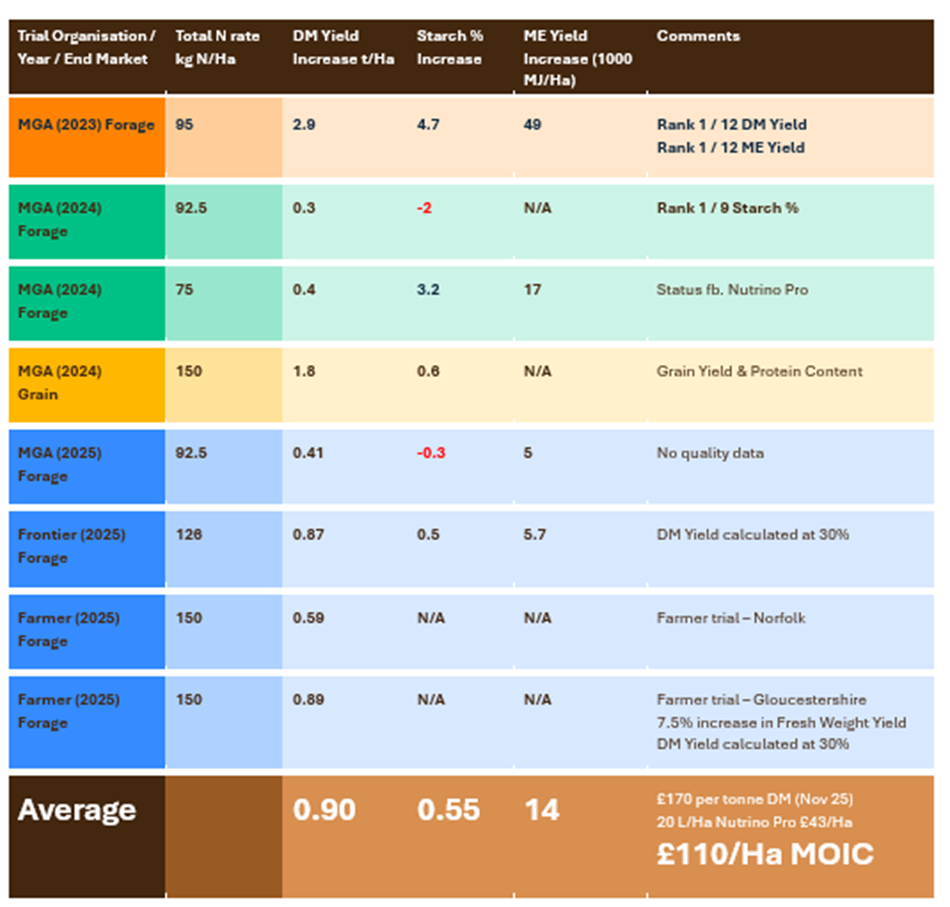
Nutrino Pro Trial Summary (UK) below demonstrates the increase in Dry Matter Yield & Quality parameters the product can deliver under varying nitrogen regimes, seasons, end markets and soil types.
Winter Wheat
In winter cereals, nutrient demand increases significantly during stem extension and grain fill. However, uptake efficiency is often affected by dry soil conditions and variable temperatures, which inevitably means root systems are limited.
Nutrino Pro can support wheat crops by:
- improving nutrient uptake during periods of peak demand to support yield
- maintaining physiological activity under stress
- replacing soil applied nitrogen, therefore reducing the cost of production due to high fertiliser prices
- supporting consistent growth and development at later growth stages when applied at GS39
Due to high fertiliser prices and long lead times, growers will be looking to replace soil applied nitrogen, particularly where only small quantities of fertiliser are required. Our experience shows it can be in wheat, if the following guidelines are adhered to.
- It is a single application of Nutrino Pro replacing a final soil applied Nitrogen dose
- You cannot double up on applications to replace additional Nitrogen
- Success significantly depends on what soil applied Nitrogen has already been applied
- For most wheat crops this would need to be a minimum of 170-180kgs N/ha
Nutrino Pro is included within later (T2) spray applications in order to support biomass and support grain fill.
Dyson Farm Research, 2024.
| Nitrogen Rate | Nutrino Pro Rate | Yield increase from Nutrino Pro |
| 118kg/ha | 20L/ha | 0.45tn/ha |
| 162kg/ha | 20L/ha | 0.7tn/ha |
| 220kg/ha | 20L/ha | 0.33tn/ha |
Interestingly Nutrino Pro outperformed Foliar N 2 (Efficient N28) for N offtake & yield at all Nitrogen rates.
In the current fertiliser landscape, improving nutrient efficiency is an economic necessity. Nutrino Pro offers a flexible solution that can be integrated into existing crop programmes to enhance return on fertiliser investment and support crop performance as well as reducing the impact on the environment.
For OSR, maize and winter cereals, improving nutrient use efficiency represents one of the most effective ways to protect yield potential in an increasingly complex growing environment.

