
How can you combat abiotic stress?
How can growers maintain yields under abiotic stress?
Abiotic stress, which is caused by several factors including drought, heat, salinity, and nutrient deficiencies, presents one of the biggest challenges for growers as our climate changes. The frequence and extremity of weather conditions globally has left many struggling, as a variety of crops are increasingly subjected to stresses that hinder growth, reduce yields, and impact quality. However, biostimulant technologies are proving effective in mitigating the adverse effects of abiotic stress on crops.
Status®, IntraCrop’s leading plant biostimulant, combines two powerful technologies: MTU® and Pidolic Acid. MTU® is a patented, award-winning molecule developed by scientists at the Institute of Experimental Botany, which has been shown to protect the plant’s photosynthetic apparatus under stressed conditions. Pidolic acid, a signalling compound in the nitrogen assimilation cycle, supports plant health by enhancing nitrogen use efficiency and reducing the build-up of toxic ammonia during stress.
Together, these technologies help crops maintain resilience and recover more rapidly from stress events, providing growers with a tool to protect crop potential and improve yield during adverse conditions.
How Does Status® Combat Abiotic Stress?
- Protecting Photosynthesis and Chlorophyll Retention: Under abiotic stress conditions, plants are subjected to increased production of free radicals, leading to cellular damage, chlorophyll degradation, and premature senescence. MTU® plays a critical role in alleviating these issues by enhancing the activity of Photosystem I (PSI), which is crucial for the plant’s photosynthetic process. This protection helps maintain chlorophyll levels, allowing for continued photosynthetic activity even under stress. As a result, plants treated with Status® exhibit increased photosynthetic output, continuing to produce energy for growth and recovery. In stressed conditions, an excess of light energy increases the concentration of reactive oxygen species (ROS) or free radicals in the plant, causing physiochemical damage to the photosystems and elevating hormones that trigger early plant senescence and reduced yield.
- Enhancing Nitrogen Use Efficiency: Pidolic acid enhances nitrogen assimilation by reducing the accumulation of toxic ammonia that can otherwise inhibit growth during stress. This increased efficiency in nitrogen use improves overall plant health, boosts growth, and ensures better nutrient uptake, which is especially important when nitrogen availability in the soil is low or when plants are stressed by environmental conditions. MTU® enhances Nitrogen Use Efficiency by increasing photosynthetic efficiency, this means plants take up more CO2 from the air. To compensate the plant increases nitrogen uptake to balance the C:N ratio. The combination of pidolic acid an MTU® in Status ® improves access to nitrogen by providing a larger root surface area.
- Faster Recovery After Stress: One of the standout features of Status® is its ability to speed up recovery once stress factors subside. When applied during periods of environmental stress, plants treated with Status® tend to recover faster than untreated crops, helping to mitigate yield losses that would otherwise result from prolonged exposure to stress.
MTU reduces stress hormone levels
Cyclic electron flow (CEF) plays a key role in protecting the photosynthetic apparatus under stress, instead of causing damage, the excess electrons are routed around Photosystem I and used to produce ATP.
After MTU treatment CEF has been shown to be 50% higher in the 21-day-old leaves in the absence of stress and almost double in drought stress plants (+ 84%). Thus, MTU treatment stimulates CEF and increases the ATP available for growth. Abscisic acid (ABA) is a major phytohormone signal produced in response to drought stress, increased ABA triggers early leaf senescence reducing yield. MTU-treated plants had only half the content of ABA content of drought-stressed control plants.
MTU alleviates abiotic stress by increasing the CEF around Photosystem I and this has two benefits:
- More ATP is produced enable the plants to continue to fix carbon and grow
- Stress hormone levels (e.g. ABA) are reduced delaying stress-induced senescence, increasing yield.
Effect of MTU on drought recovery
Plants were left to wither and then were re-watered. The photo below was taken 24h after re-watering and shows that MTU treated plants recover from abiotic stress faster.
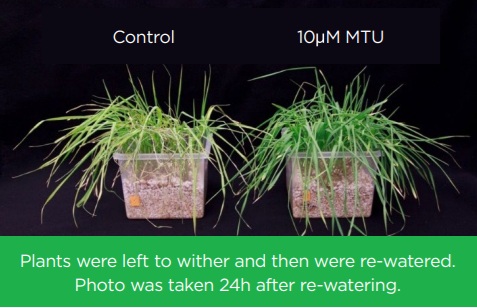
Plant biostimulants cannot replace water, they can protect and reduce the severity of impact of drought and enable the plant to recover once the stress is alleviated. In this trial water was withheld for 21 days, plants treated with MTU recovered much faster – this photo was taken 24 hours after re-watering.
Across 7 trials on winter wheat, spring barley and maize, under drought-stressed conditions, the Status-treated plants had significantly higher (p<0.01) root dry weight compared to the droughted control. The glasshouse abiotic stress trial was conducted by the University of Nottingham in 2023 at three different growth stages on winter wheat (cv Skyfall) and spring barley (cv LG Diablo) and one on maize (cv KWS Calvini). Mean of 10 replicates, measurements taken 21 days after treatment.
For more information on Status® and how it can benefit your crops, contact IntraCrop or visit our product page.
Find out more about abiotic stress.

