
Prosper ST contains potassium phosphite combined with a range of nutrients in a readily compatible seed treatment formulation. When applied to seed, it increases the level of the cytokinin cis-Zeatin that boosts both primary and lateral root growth. A typical response is a 30% increase in root biomass. New research has also demonstrated an increase in nitrate reductase activity resulting in increased nitrogen assimilation and shoot growth. Propser ST can be sequenced with a foliar application of Status or Prosper Plus

Independent university trials investigated the effect of Prosper ST on the germination of both winter wheat and oilseed rape at a range of different temperatures (7°C, 10°C and 15°C). Not surprisingly increasing temperature increased the rate of germination, however, even under ideal laboratory conditions Prosper ST increased the speed of germination of OSR at three temperatures tested and for wheat at 7°C and 10°C.
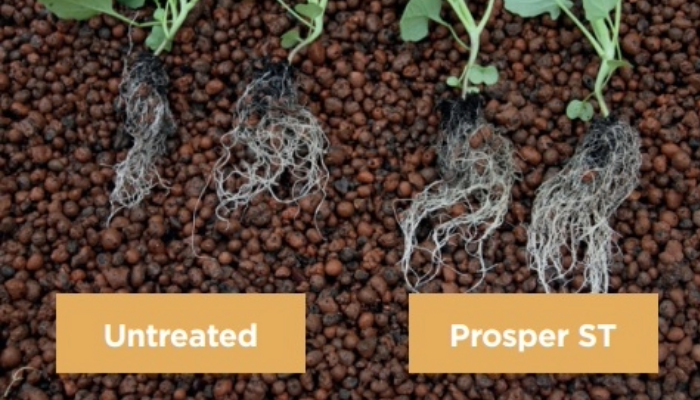
The potassium phosphite contained in the Prosper ST formulation increases the level of the cytokinin cis-Zeatin (cZ) which leads to longer primary root growth and more lateral root development. Root biomass is typically increased by 30% and the larger root system allows improved access to soil nutrients and moisture which in combination with stimulation of the enzyme nitrate reductase supports faster nitrogen assimilation and subsequent increase in shoot growth.

Independent trials conducted by contract research organisations have demonstrated that, by improving crop establishment and building resilience, Prosper ST seed treatment can significantly increase yield. This has been evidenced in sunflower, with an increase of 0.5t/ha (treatment rate 3l/t) and in grain maize, with an increase of 0.9t/ha (treatment rate 4l/t).
| Contains | % w/w | g/l | |
| Nitrogen | N | 2.40 | 31.9 |
| Phosphorus | P2O5 | 24.40 | 324.8 |
| Potassium | K2O | 5.60 | 74.5 |
| Magnesium | MgO | 0.59 | 7.85 |
| Manganese | Mn | 0.60 | 7.98 |
| Zinc | Zn | 1.18 | 15.694 |
| Copper | Cu | 0.19 | 2.54 |
| Boron | B | 0.05 | 0.665 |
| Iron | Fe | 0.05 | 0.665 |
| Molybdenum | Mo | 0.02 | 0.266 |
Intracrop is science-led. Our biostimulants/adjuvants are developed alongside universities, research institutes and independent scientists. Independent trials, financed significantly by our parent company Frontier, produce clear, reliable results. We work alongside agronomists to ensure we understand the key issues being experienced on the farm, by crop and region. Our biostimulant and adjuvant technologies and products are designed and rigorously tested to address these issues and support farmers in maximising productivity in crop production.
Plant biostimulants are responsible for improving a wide range of vital crop inputs, including but not limited to, increasing productivity, mitigating against environmental changes and encouraging more sustainable farming practices. They also contribute towards improving our ability to address global concerns such as soil quality and biodiversity.
Intracrop currently offers four biostimulant technologies: MTU, R100, phosphite and pidolic acid. These technologies are used in varying combinations in our biostimulant products. We recommend that biostimulants are used in sequence to enhance crop development throughout the season from rooting and establishment to final yield.
A wide range of crops can benefit significantly from biostimulant use. Intracrop offers biostimulants that are appropriate for: cereals, maize, oilseed rape, fruit, olives, potatoes, vegetables, , sugar beet and sunflower. Our biostimulants have undergone rigorous testing proving their efficacy on the suggested crop as well as establishing the most impactful application times and combinations through our YieldBuilder programme.
Biostimulants work in a range of ways to improve nutrient use efficiency (NUE). Not only can they physically increase root size, giving the plant a larger surface area to absorb nutrients, but they stimulate nitrogen assimulation and improve uptake of foliar applied nitrogen based products. Using biostimulants alongside fertiliser use will significantly improve the efficacy of that fertiliser. Our biostimulant technologies can support you in increasing NUE of a wide variety of crops, reducing your impact on the environment whilst maintaining profitability, yield & quality.
Plant biostimulants increase root and shoot growth, leaving them both better established and more able to access the nutrients and water that they need to survive abiotic stress. They also boost the plant’s metabolic efficiency and chlorophyll concentration during periods of stress, increasing nutrient use efficiency, enhancing crop vigour and yield.

‘Science led, Agronomy driven’ are registered trademarks of IntraCrop Ltd.
All trademarks acknowledged
©IntraCrop 2026

