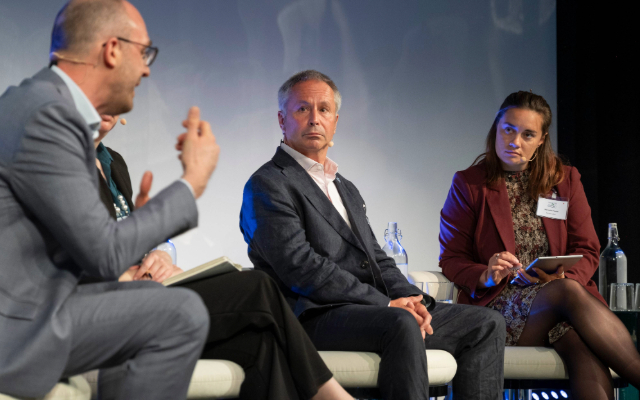
Mark Palmer drives change at the EBIC Summit
EBIC Summit a success for IntraCrop
At the 2025 EBIC Summit in Brussels, IntraCrop’s Commercial Director Mark Palmer brought his voice to the debate on how biostimulants can meet the growing demands of both farmers and the wider food supply chain. As Co-Chair of EBIC’s MTS Steering Group, Mark spoke candidly about the opportunities and roadblocks facing the sector, particularly in the context of regulation and the future of sustainable farming. (Photo courtesy of EBIC.)
Elevating the farmer toolbox
Mark participated in a morning panel alongside representatives from Paula de Vera, COPA-COGECA, and Nicolas Willaume, ICL Group, discussing how biostimulants can help enhance the farmer’s toolbox in a changing climate and market. The group tackled big-picture challenges: from soil degradation and climate volatility to the economic realities of farming today.
He underscored the practical impact of NUE-focused biostimulants, which IntraCrop has long championed.
“At the Biostimulants World Congress in Miami,” he said, “I was speaking to both grain buyers and distributors. American distributors were defensive of fertilisers and did not want to talk about NUE as they were concerned about loss of yield or quality. But the buyers say that 90% of their emissions are in their supply chain, and fertilisers make up half of that — and they buy the grain! So that is the direction. When you speak to any end user, the same story comes out.”
Mark reiterated that for manufacturers who are obliged to monitor their environmental impact, fertilisers are energy-intensive and emission-heavy, but that biostimulants offer proven solutions to reduce nitrogen inputs while improving yield and profitability.
He referenced multiple trials where products like Status® and Talisman® demonstrated increases in both root and shoot biomass, delivering higher NUE and more resilient crop growth under stress. These technologies can enable increased yield while supporting growers, distributors and manufacturers in meeting economic and environmental targets.
Regulation: a double-edged sword
As a UK-based business, IntraCrop operates outside the immediate scope of the EU Fertilising Products Regulation (FPR), but Mark addressed the importance of regulatory alignment and accessibility across Europe.
“The FPR has been useful in Europe,” he said, “but it has also created challenges, especially with REACH+, microbials and animal by-products. For SMEs, the costs involved in meeting these regulatory hurdles are significant, and they risk stifling innovation.”
He warned that unless the regulatory environment evolves to support small and medium-sized innovators, the industry risks losing its dynamic edge.
“If we lose that drive of small businesses growing and expanding the market, we lose our leadership position,” he said, echoing broader Summit discussions around the need for predictable, science-based pathways to market that don’t exclude high-quality, research-driven SMEs.
A window of opportunity at the EBIC Summit
A key theme throughout the Summit was farmer adoption, something Mark and IntraCrop believes is gathering momentum, but still needs targeted support to maintain.
“We need to capitalise on and keep that change through knowledge transfer of effective products that farmers can use to drive their ROI and make money,” he told attendees.
With biostimulant use steadily increasing, IntraCrop is committed to ensuring that adoption is not just a trend, but a lasting shift supported by robust data, agronomic advice, and meaningful return on investment for growers. Science-led, field-proven innovation must be paired with accessible regulation and farmer-first thinking. As the biostimulants sector matures, IntraCrop will continue to advocate for the tools and policies that allow for smarter, more sustainable farming.
18th June 2025
