
What impact does Status® have on Spring cereals?
The progress for Spring cereal drilling is currently highly variable across the UK due to the wet weather of the last 18 months. Although some are close to 90% drilled, other growers are only just getting started. Regardless of their progress, focus will now turn to maximising yield and quality in a season that has been delayed by the extreme rainfall this Spring. With the yield of spring cereals reliant in part on establishment and rapid early growth, there is currently a threat to growers’ return on investment.
How can Status® help cereals catch up?
Short season crops like Spring barley are generally very responsive to biostimulants as spring cereal crops are typically able to build biomass very quickly. Unfortunately, they are also drought-prone, making Status® a practical choice for making a positive impact on all the main yield building metrics in barley as well as protecting the crop from climate-related stress.
When should growers use Status® on Spring cereals?
Waiting for a nutrient deficiency or stress event to happen before trying to resolve the issue can be detrimental to yield. To get the most from biostimulant technologies, it is important to avoid applying them to an already exhausted plant. Pushing the crop to deliver its full potential using a programmed approach of biostimulants alongside good nutrition as part of your crop treatment programme is the most effective route. Biostimulants and nutrition can be used sequentially to alleviate yield reduction as part of a Yieldbuilder programme, which growers are able to speak with their agronomist about. Typically, Spring cereals are more responsive to foliar biostimulants, that can help improve canopy cover, build biomass and conserve moisture. Status® is very easy to tank mix and as such can be added to existing spray programmes.
But what happens if Spring cereals don’t suffer a stress event?
If a stress event should occur, Status® protects the photosynthetic apparatus and improves plant resilience, resulting in quicker stress recovery, protecting yield. In healthy conditions, Status® increases green leaf retention and improves nutrient use efficiency, resulting in higher yield and quality. If Status® is used and a stress event does not occur, benefits will still be seen.
What evidence do we have on the impact of Status® on Spring barley?
As a science-led organisation, we thoroughly test all label claims in independent trials across varying countries, crop types and conditions. Status® has proven to have a positive impact on all of Spring barley’s main yield building metrics, including ears/m2, grains/ear and TGW. In an Independent Trial conducted by Dr Bezdickova, in Ditana, Czechia, Spring Barley was drilled on 15th March 2022. It was subsequently treated with Status at 0.25 l/ha at BBCH27-30 in May 2022 and harvested in August 2022. The results showed an increase across all metrics, representing a 7% increase in yield.

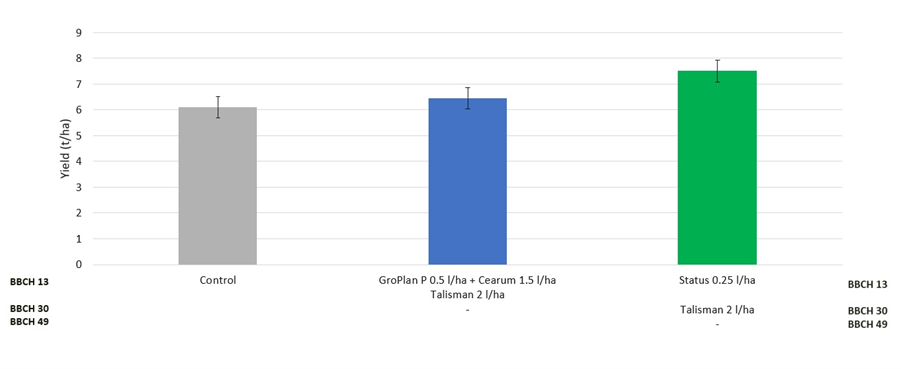
In 2022, a UK trial in Northumberland on Laureate Spring Barley ran to demonstrate the effectiveness of a Yieldbuilder approach. There were six replicates each one a 100m2 plot. Status® was applied at 0.25 l/ha at BBCH13 followed by Talisman at 2 l/ha at BBCH30. The two products used in sequence were shown to increase yield by 1.4t/ha and improve nutrient use efficiency by 24.7% relative to an untreated control. All grain nitrogen levels remained within the desired specification.
Find out more about Status®, Talisman® or Yieldbuilder.

