How does Status® improve Nutrient Use Efficiency (NUE)?
Status® impresses in NUE trials
During 2023, Status® was trialled across a variety of crops and countries to prove its efficacy in improving Nutrient Use Efficiency (NUE), with impressive results. The trials, conducted on oilseed rape, wheat, oats, maize, sunflower, spinach and rocket, were run in France, Denmark, Ireland, Hungary, Italy, the Netherlands and Great Britain.
Excellent results were recorded despite 2023 presenting extremely variable weather conditions. After a prolonged dry period in March and April, Europe experienced one of its wettest springs since 1991. This was followed by some of the highest global temperatures ever recorded in July. Despite this, most of the trials presented significant yield increases and notable improvement in NUE.
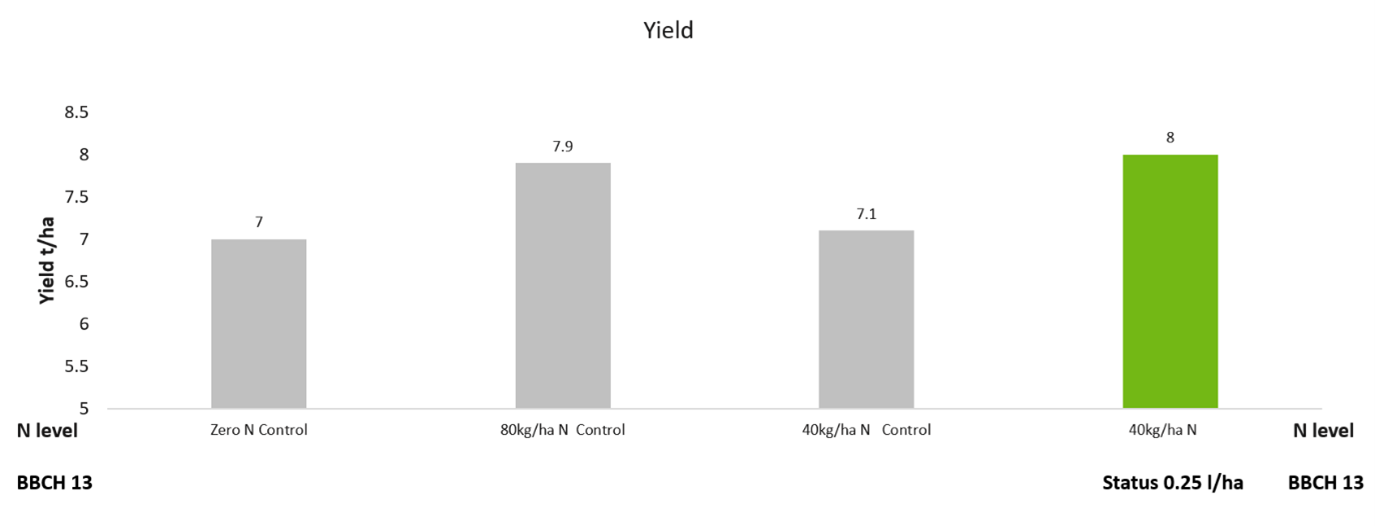
The best results in these series of trials came from Hungary, where an extended drought prior to their spring rainfall resulted in their crops coming under stress. In Szalanta, one treatment of 0.25l/ha of Status® was applied to grain maize at BBCH 13. This resulted in a yield increase of 0.9t/ha under a 40kg/ha nitrogen regime when compared with the 40 kg/ha nitrogen control. In this trial, 40 kg/ha nitrogen in combination with one application of Status® yielded the same as the 80 kg/ha nitrogen input. This would therefore provide £44.50/ha return on investment (based on a selling price of ~£180/t and a Nitrogen price of £1.10/kg).
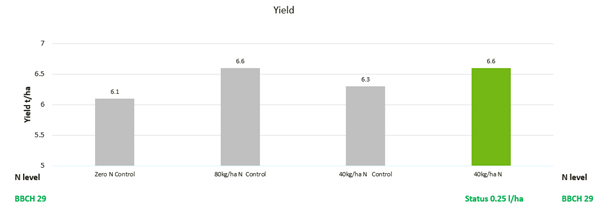
In Gare, Hungary, winter wheat was treated under a similar protocol as the Szalánta maize. In the presence of one application of Status® at 0.25l/ha at BBCH 29, yield increased by 0.3t/ha under a 40kg/ha nitrogen regime. This trial presented clear benefits to nutrient use efficiency, with the 40 kg/ha nitrogen and single application of Status® yielding the same as the 80 kg/ha nitrogen input, showing a similar trend to the maize trial in Hungary.
In trials on sunflower (also in Szalánta, Hungary), one application of Status® at 0.25l/ha outperformed the 40 kg/N control on NDVI and SPAD (chlorophyll concentration) imagery, as well as the higher nitrogen control (67 kg/N). In terms of yield, one application of Status® at 0.25 l/ha applied under a reduced 40 kg/N regime yielded the same as the 67 kg/N control.
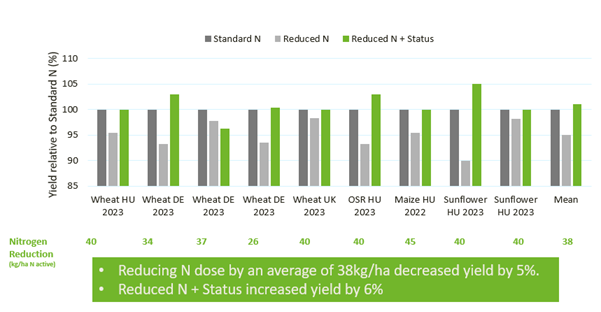
In summary, these results clearly demonstrate Status’® ability to support a variety of crops through periods of extreme weather and temperature, protecting or even increasing yield despite a reduced nitrogen regime. As is typical in our trials, the nitrogen dose was reduced by 38 kg/N across wheat, OSR, maize and sunflower trials. When looked at in isolation, the reduction without inclusion of Status® led to on average a 5% reduction in yield versus the standard N-rate control. However, where Status® was applied under a reduced nitrogen regime, on average, it increased the yield above the standard N-rate control by 6%.
Status® is able to offer these results through its biostimulant technologies’ complementary modes of action. By combining the effects of MTU® on photosynthesis and pidolic acid on nitrogen assimilation, Status® increases green leaf retention and improves nutrient use efficiency. This ultimately results in higher yield and quality. In stressed conditions, it protects the photosynthetic apparatus and improves plant resilience, resulting in better rooting and quicker stress recovery, thus protecting yield under lower nitrogen regimes.
These results are of importance to growers from an economic perspective, as their return on investment is higher. As shown below, they can save money on reducing fertiliser spend without compromising on yield or quality. Reducing nitrogen inputs also benefits the environment and helps to reduce the carbon emissions attributed to the inefficient use of fertilisers by leaching, volatilisation, poor rooting and reduced uptake and assimilation of nutrients from the soil.