
Is Nutrient Use Efficiency going to be key profit this year?
As of March 2026, growers across the globe are facing a familiar but increasingly challenging equation: rising input costs combined with uncertain grain prices. Fertiliser markets are experiencing significant volatility and renewed price spikes are negatively impacting farm budgets.
Growers are juggling yield goals, input prices and crop decisions while trying to make sense of their budgets. In this environment, the key question may need to shift from “How much nitrogen should we apply?” to “How efficiently can crops use the nitrogen we provide?”
Ensuring crops use applied nutrients efficiently will be essential to protect margins this season. That means focusing on nutrient use efficiency (NUE) and making sure every nutrient applied on farm delivers maximum value.
Nutrient Use Efficiency (NUE) refers to the plant’s ability to optimise the uptake and utilisation of nutrients, leading to improved growth, yield, and environmental sustainability. Efficient nutrient use reduces losses to the environment, maximising fertiliser investments and contributing to sustainable food production.
The fertiliser challenge
Nitrogen remains the most essential nutrient in agriculture. However, despite advancements in nitrogen fertilisers, they remain highly inefficient. On average, 60-70% of applied nitrogen is taken up by crops, while the rest is lost to volatilisation, leeching, run off and denitrification, leading to unnecessary cost and environmental damage.
With fertiliser prices rising, these inefficiencies become even more significant. Every unit of nitrogen that fails to reach the crop is both wasted investment and lost yield potential.
This raises an important question for growers this season: are you getting the most out of your fertiliser applications?
Why nitrogen use efficiency matters
Nitrogen use efficiency refers to how effectively crops utilise available nitrogen to grow and therefore has a direct impact on crop yields. Improving NUE allows growers to maximise the value of every kilogram of fertiliser applied.
When plants efficiently absorb nitrogen, not only do they grow more vigorously, resulting in higher yields and better quality, but there is less reliance on traditional fertilisers, lowering costs for farmers and supporting them with the achievement of ESG and Scope 3 targets.
Improving nutrient use efficiency with Status®
At IntraCrop, we are dedicated to helping growers maximise nutrient use efficiency (NUE), ensuring that essential nutrients such as nitrogen, phosphorus, and carbon are utilised more effectively by crops.
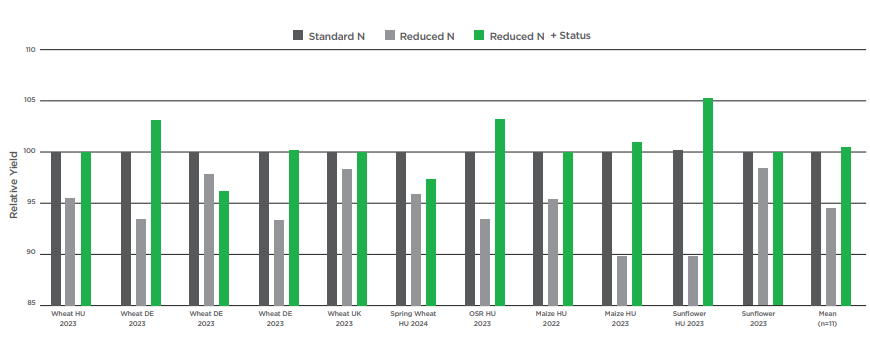
This chart shows results from 11 nitrogen use efficiency trials across Hungary, Germany and the UK. Higher yields were achieved when Status was applied under a reduced nitrogen regime compared to standard nitrogen programmes without Status®
IntraCrop’s flagship product, Status® is CE-marked under EU Fertilising Products Regulation for Nitrogen Use Efficiency. Status® has been trialled across a variety of crops and countries to prove its efficacy in improving Nitrogen Use Efficiency, with impressive results.
Status® contains the award-winning molecule MTU®, partnered with pidolic acid. MTU® and pidolic acid offer complementary modes of action to increase plant response, by combining effects of pidolic acid on nitrogen assimilation and MTU® on photosynthesis.
As photosynthesis fixes carbon from the atmosphere, the plant must simultaneously increase nitrogen uptake from the soil to preserve this C:N balance. Any constraint on nitrogen acquisition during early spring growth can therefore limit crop development and yield formation.
Status® supports this process through its unique mode of action. By enhancing the activity of Photosystem I and II and increasing photosynthetic pigment concentration, Status elevates the rate of carbon fixation. As carbon assimilation increases, the plant’s requirement for nitrogen rises concurrently, driving improved nitrogen uptake and utilisation efficiency.
The IntraCrop team recommends an application of Status at T0 on winter wheat, which strengthens performance by:
- Improving nitrogen use efficiency (NUE)
- Promoting deeper, more active rooting, allowing crops to access more nutrients from the soil
- Increasing resilience to late-season moisture deficits
- Enhancing yield potential, supporting a strong return on investment
With fertiliser markets remaining volatile and crop margins under pressure, the focus for many growers this season will be maximising the value of every input.
Improving nutrient use efficiency represents a practical and increasingly important pathway to maintaining profitability. By ensuring crops can use nutrients more effectively, growers can reduce losses, protect yields and improve the return on fertiliser investments.
In an environment where input efficiency may matter more than ever, NUE could prove to be one of the most valuable tools to increase Net Margin per Hectare in challenging grain market conditions.

