
How does Impetus® improve crop performance under stress?
Modern crop production is increasingly challenged by abiotic stress. Drought, heat, salinity and nutrient shortages are occurring more and more frequently and with greater intensity. This will in turn disrupt plant metabolism and reduce yield potential. Impetus® has been developed to address these challenges by supporting two of the most stress-sensitive physiological processes in plants: photosynthesis and nitrogen assimilation.
Supporting photosynthesis through MTU®
One of the main components of Impetus® is MTU®, IntraCrop’s patented single-molecule biostimulant. MTU® directly influences on Photosystem I (PSI), where it enhances cyclic electron flow (CEF) within the chloroplast. Under stress conditions, excess electrons generated during photosynthesis can damage the photosynthetic apparatus, which accelerates senescence and reduces energy availability for growth.
By promoting CEF, MTU® safely redirects excess electrons, increasing ATP production while protecting PSI from oxidative damage. This helps the plant maintain chlorophyll content, delaying age- and stress-induced senescence. In turn, this supports sustained carbon assimilation. As a result, crops treated with MTU® remain greener and photosynthetically active for longer, even during periods of stress.
Field and laboratory studies have shown that MTU® improves nitrogen use efficiency and yield in optimal conditions and under stress. In non-stressed situations, yield improvements of 5–12% have been recorded, while under stressed conditions MTU® has delivered yield increases of 7–20%.
Rebalancing nitrogen metabolism with pidolic acid
Nitrogen assimilation is highly sensitive to stress and can quickly reduce if a plant is struggling. When plants experience drought, extreme heat or salinity or nutrient limitation, metabolic processes often shifts focus from growth to respiration. This can cause the nitrogen assimilation cycle to reverse, leading to the accumulation of toxic ammonia, chlorosis and the catabolism of internal reserves.
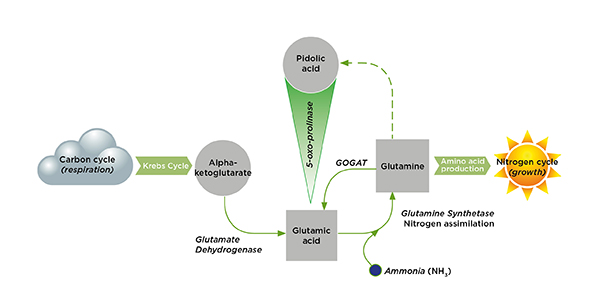
Pidolic acid, the second technology within Impetus®, plays a vital role in ensuring equilibrium is achieved between growth and respiration. Under normal conditions, pidolic acid enhances nitrogen assimilation, supporting protein synthesis and biomass accumulation. Under stress, it helps prevent ammonia build-up by re-establishing the balance between carbon and nitrogen metabolism, allowing growth processes to resume more rapidly once conditions improve.
Trials have evidenced that pidolic acid increases root and shoot biomass, with particularly noticeable differences under drought stress, where treated plants outperform unstressed controls significantly.
Complementary biostimulant support
Impetus® also contains proline and betaine, amino acids that contribute to osmotic regulation, membrane protection and recovery following stress. These compounds support rapid tissue regeneration and help maintain cellular integrity during adverse conditions.
The final ingredient is Ascophyllum nodosum seaweed extract, which is rich in bioactive compounds that enhance rooting (and therefore nutrient uptake) and stress tolerance. Adapted to the extreme conditions of the intertidal zone, Ascophyllum nodosum contributes naturally evolved mechanisms that help plants cope with all kinds of abiotic stress.
A systems-based approach to NUE and resilience
By combining MTU®’s protection of photosynthesis with pidolic acid’s regulation of nitrogen metabolism and the supportive effects of amino acids and seaweed extracts, Impetus delivers a sophisticated aid for improving crop resilience. Rather than forcing growth through higher inputs, it enables crops to use nutrients more efficiently, maintain metabolic stability under stress and recover faster.

