
How do biostimulants impact Mediterranean crops?
Over the last year, we have released several technical articles exploring the impact of our biostimulant technologies on a variety of broadacre arable crops, including wheat, maize and other cereals, oilseed rape and even sunflower. However, our products are also proving to have a significant impact on other crops, such as fruit and vegetables, with promising results shown in Scotland on trials of carrots, broccoli and brussels sprouts last year, as well as good responses in apples, cherries and vines. At the same time, trials were being run in the Mediterranean. The results proved very promising.
How do biostimulants impact industrial tomatoes?
A 2023 trial on industrial tomatoes – of the variety Tyson F1 – in Italy investigated the effect of applying Status® and Nutrino Pro on marketable yield, fruit diameter, fruit colour and fruit acidity.
Status® contains our award-winning molecule MTU® and pidolic acid. They offer complementary modes of action to increase plant response, by combining effects of MTU® on photosynthesis and pidolic acid on nitrogen assimilation. In healthy conditions, Status® increases green leaf retention and improves nutrient use efficiency, resulting in higher yield and quality. In stressed conditions, Status® protects the photosynthetic apparatus and improves plant resilience, resulting in quicker stress recovery, protecting yield.
Nutrino Pro also contains pidolic acid, as well as another of our technologies, R100®. It is a rainfast, low scorch controlled release foliar nitrogen which also contains magnesium and sulphur. Nutrino Pro releases nitrogen over a 6-8 week period, whilst pidolic acid improves nitrogen assimilation and increases growth and yield. R100® improves the uptake and utilisation of the magnesium component (the central molecule in chlorophyll). It also boosts cytokinin levels in plant tissues, increasing photosynthetic capacity and maintaining green leaf retention.
The table below shows the treatments and application timings used.
| Treatments | BBCH60 (start of flowering) | BBCH71 (first fruit cluster) | BBCH75 (5th fruit cluster) | BBCH81 (10% fruit ripened) |
|---|---|---|---|---|
| Control | - | - | - | - |
| Status® and Nutrino Pro Sequence | 0.25l/ha (Status®) | 4l/ha (Nutrino Pro) | 4l/ha (Nutrino Pro) | |
| Nutrino Pro (two applications) | 4l/ha | 4l/ha | ||
| Status® (two applications) | 0.25l/ha | 0.25l/ha |
A significant improvement in fruit colour was observed across all treatments compared to the control with the tomatoes that received the sequenced treatments of Status® and Nutrino Pro showing the most significant improvement. Fruit colour is rated on a scale from 1 to 12 (see image below). The control recorded a score of 11.19, whilst the Status® and Nutrino Pro treatment received a near-perfect score of 11.87.

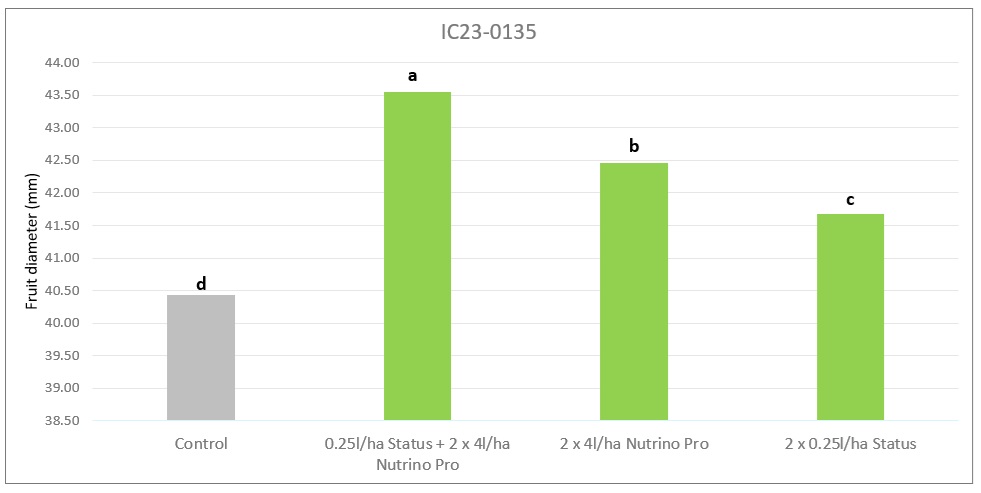
When it came to fruit diameter, all treatments were significantly larger than the control. The double application of Status® resulted in a fruit diameter of 41.67mm. However, the tomatoes that had the sequenced treatment of Status® and Nutrino Pro achieved the highest diameter of all treatments at 43.55mm, significantly higher than all of the other treatments in the trial. This represented a difference in diameter of more than 3mm.
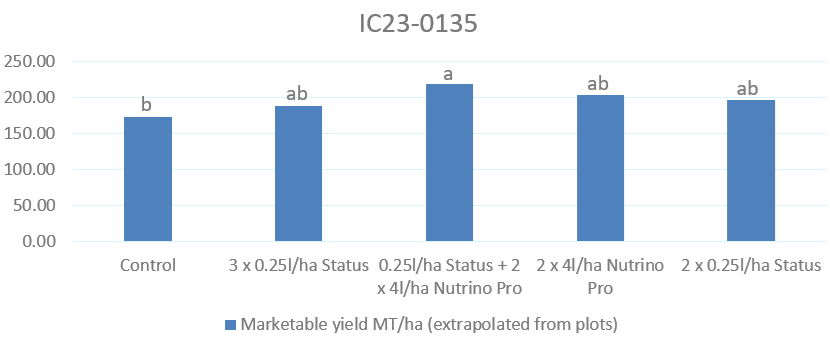
Marketable yield was increased with all biostimulant treatments, however the sequence of Status® followed by Nutrino Pro was most effective, yielding 217.83t/ha. This was a statistically significant result compared to the control which yielded 173.19t/ha, an increase of 26%. In Italy, a typical yield of tomatoes would be 120 t/ha, with many growers only achieving around 70 t/ha. Being able to attain more than 200 t/ha in the treated plots showed that biostimulants can help growers achieve their sustainability goals and increase marketable yield by improved efficiency of both water and nutrients.
With temperatures in Europe regularly become extreme, biostimulant use to protect against drought and heat is becoming increasingly common. Their use will enable better Nutrient Use Efficiency for optimisation of cost of fertilisation and may enable reduced irrigation. Trials on tomatoes are ongoing and further results will be provided when they are available.
What impact do biostimulants have on Olives?
In Morocco, a similar trial as that on the tomatoes was conducted on olives looking at fruit size, yield and oil content.
| Treatments | BBCH70 | BBCH79 |
|---|---|---|
| Control | - | - |
| Status® (one application) | 0.25l/ha | |
| Status® (one application) | 0.5l/ha | |
| Status® (two applications) | 0.25l/ha | 0.25l/ha |
| Status® (two applications) | 0.5l/ha | 0.5l/ha |
| Status® and Nutrino Pro Sequence | 0.25l/ha (Status®) | 20l/ha (Nutrino Pro) |
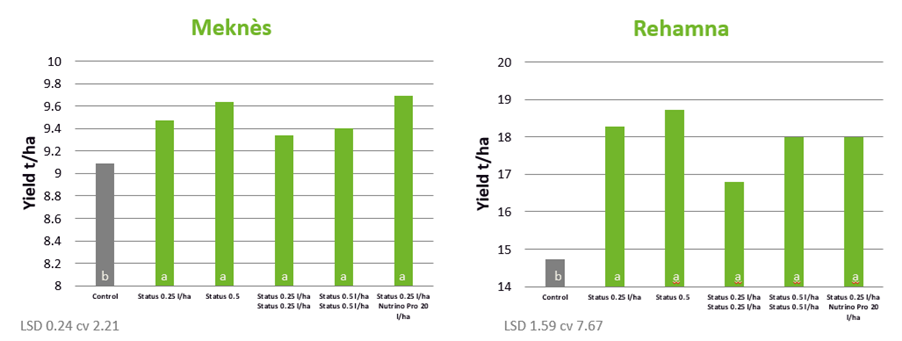
These trials were conducted in two different locations, Meknes and Rehamna. Samples from both trials showed a significant increase in length and width of olives of up to 10%. This, of course, led to an uplift in yield, with the sequence of Status® and Nutrino Pro offering the best result in Meknes (an increase of 0.6t/ha), with the single application of Status® in Rehamna leading to an additional 4t/ha. This represents a 7% and 27% increase in yield respectively.
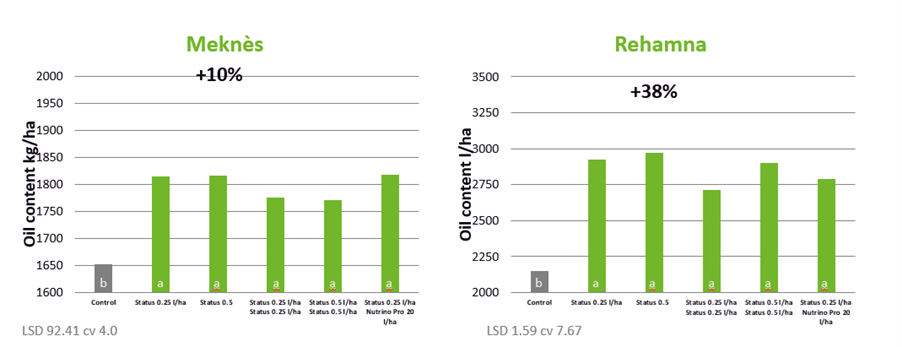
Oil content also increased at both trials. Again, the Rehamna trial showed the most improvement, with a 38% increase in l/ha. The implication on the profit of the grower producing olives for olive oil was, therefore, significant.
Further trials were also conducted on olives in Spain, where a single 0.25l/ha application of Status® was made in April over 4.5ha of irrigated trees, shortly after fruit set.
SPAD readings were taken throughout, with a significant improvement in SPAD recorded on the Status®-treated trees in October and November compared to the control trees.

By harvest, this had translated into a 10% increase in yield and an 8% increase in oil production. Additionally, the quality of the oil was impacted, with Status® improving the beneficial properties by increasing oleic acid and Omega-type fatty acids. Status® reduced polyunsaturated fatty acids, while increasing monounsaturated fatty acids. This indicates a healthier fatty acid profile.
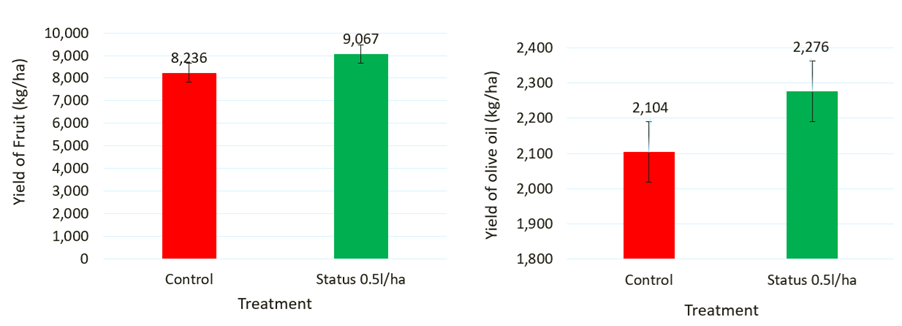
As evidenced by the data, biostimulant technologies have a positive impact on yield and quality in the Mediterranean. Further data will be gathered this year as we are currently conducting trials on cucumbers, lettuce and peppers, with further research on tomatoes. We will bring further information when it becomes available.

