
How can Status® mitigate against nutrient loss?
Over the last 18 months, there has been a record amount of rainfall in England, which will inevitably have led to nutrient loss from the soil by leaching. This, along with reduced microbial activity and lower than optimal pH, has left soils lacking in nitrogen. Many crop types will also be facing lazy rooting because they have not been subject to dry conditions. Thankfully, there are still ways to intervene and protect yields in these unfavourable conditions.
Nitrogen applications may have been disrupted throughout April due to wet field conditions impacting the ability to travel. However, it is important that NUE is a high priority following applications that were made in April and those to be made in May. If Ammonium Nitrate is leached through the soil and crops cannot access it, growers run the risk of diminishing their ROI. In order to mitigate against losses, growers should consider using biostimulant technologies to increase nutrient use efficiency and maintain crop yields
What causes a reduction in Nutrient Use Efficiency (NUE)?
Efficient use of nutrients is especially important where there is a reduction in those readily available. There will be a notable drop in nutrient uptake if:
- Conditions become overly wet and nutrients are leached
- Root systems do not properly establish and therefore less surface area is available for the plant to take up available nutrients
- Suboptimal pH of the soil
- We experience drought and crops undergo heat stress or cannot access water and therefore cannot metabolise and take up nutrients optimally
Unfortunately, growers are already experiencing many of these conditions and if this wet weather is followed by periods of high temperatures and dry spells, crops will be put under even more stress.
How can biostimulants improve nutrient use efficiency?
Although conditions have been challenging, growers can still protect their investment with biostimulant applications to improve NUE through the spring and summer to stimulate nitrogen assimilation and improve uptake of foliar applied nitrogen-based products.
Status® improves NUE through the complementary mode of action of its two technologies. MTU® delays age-related senescence of leaves and improves chlorophyl retention, giving plants a higher photosynthetic activity. To maintain the correct carbon to nitrogen ratio, nitrogen uptake is increased due to increased carbon fixation as a result of enhanced photosynthesis. At the same time, Pidolic acid increases nitrogen assimilation, acting at a signalling compound right at the heart of the nitrogen assimilation cycle.
What evidence do we have of improved NUE?
As a science-led organisation, we have run 10 independent trials on nutrient use efficiency across a range of countries, including the UK, Hungary and Germany, to ensure that products are meeting label claims.
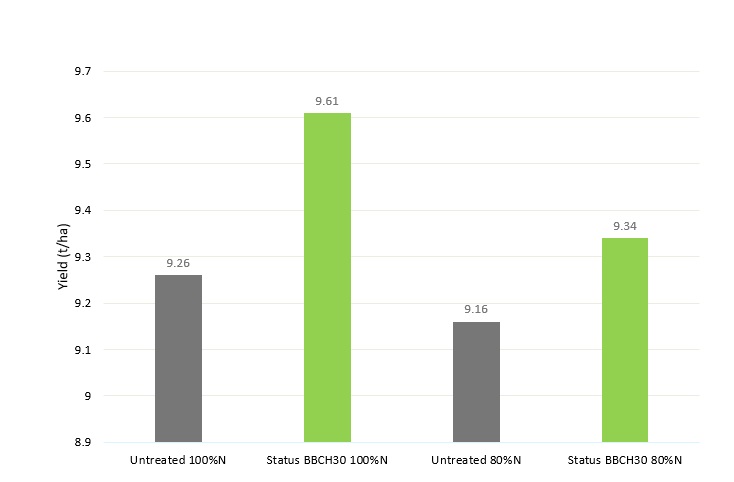
In eastern Germany, an independent distributor trial evidenced that an application of Status® at BBCH30 under a 100% N regime increased yield by 0.35t/ha, and under a reduced Nitrogen regime, an application of Status® resulted in a yield that was even higher than seen in the 100% N control.
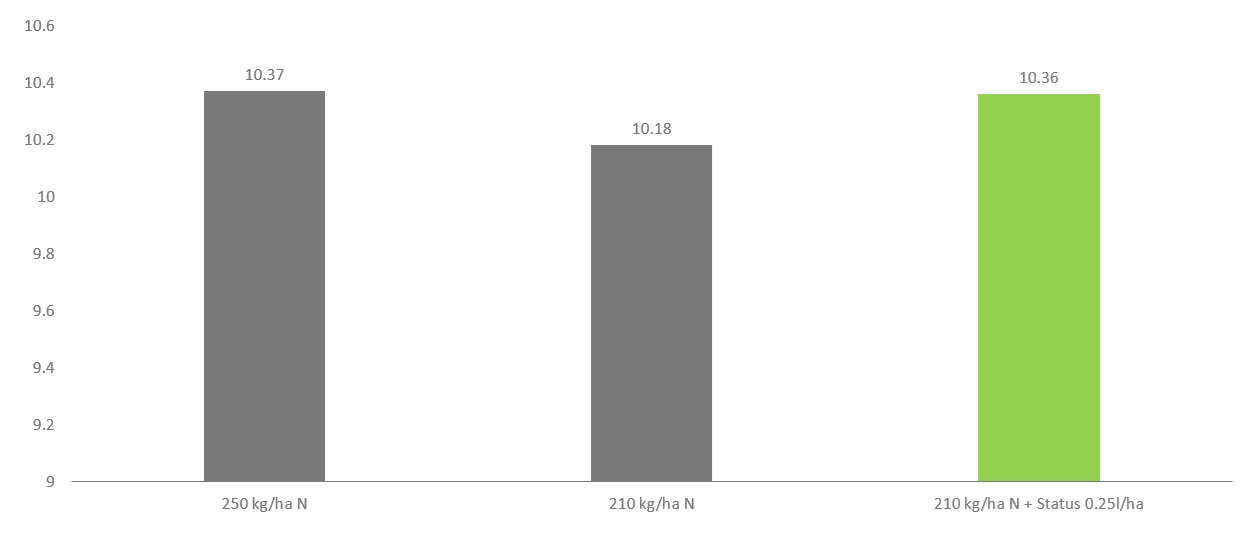
In 2023 UK trial, reducing the nitrogen input by 40kg/ha to 210kg/ha decreased yield by 0.19t/ha, in contrast where the reduced N dose was followed an application of Status® the yield was the same as 100% N control.
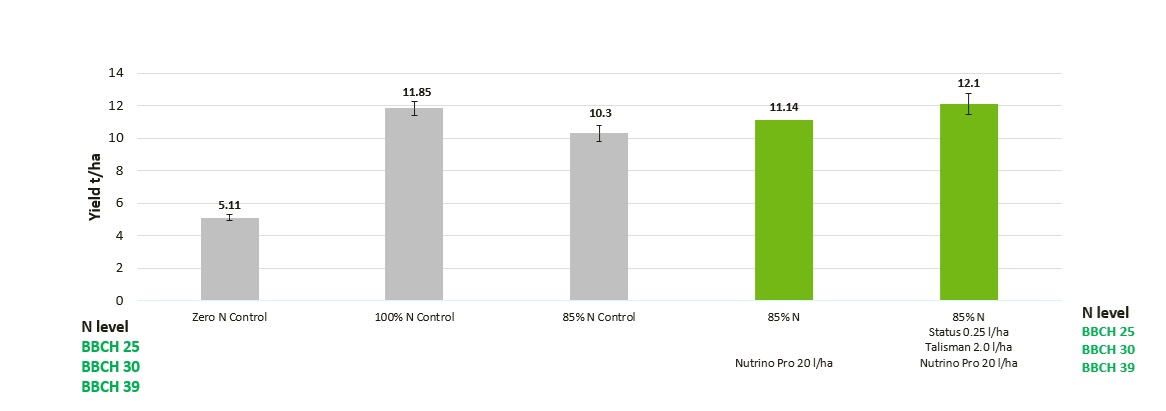
In the trial below, reducing Nitrogen by 15% sees yield drop by 1.55t/ha. However, under a Yieldbuilder regime where Status® is sequenced with Talisman® and Nutrino Pro, under the reduced N programme we see an increase of 1.8t/ha and 0.25t/ha in yield compared to the 80% Nitrogen and 100% Nitrogen controls respectively.
What does this mean for growers?
After the extreme rainfall experienced in the UK, Nitrogen is less available to our crops and nutrient loss will be significant in some areas of the country. However, biostimulant technologies can still support growers in the improvement of nutrient use efficiency and they have been evidenced to protect or even increase yield in challenging conditions. Take action now to support your crops against the extreme weather and nutrient loss we have faced – speak with your agronomist about protecting your yields or get in touch with us today.

