
How can Dimethyl Sulphone increase nutrient uptake?
Dimethyl Sulphone and Nutrient Use Efficiency
Growers are facing increasingly challenging conditions due to an ever-changing climate, more extreme weather events and higher demand from the food supply chain. As this happens, regulators are imposing ever tightening fertiliser regulations. The need for more innovative technologies to support these needs and create more efficient crop inputs continues to rise. Dimethyl Sulphone is one such technology. It is a sulphur-based plant biostimulant that enhances nutrient uptake, supports protein synthesis, and contributes to improved crop quality and yield.
What Is Dimethyl Sulphone?
Dimethyl Sulphone is an organic compound containing sulphur with unique biostimulant properties. It can be found in Talisman® and has been proven to enhance foliar nutrient absorption and support plant metabolism under both normal and stressed conditions.
Its core function is to increase membrane permeability, enabling more nutrients — especially sulphur — to be transported through plant cell walls, becoming more readily available to the crop.
Why Sulphur Matters
Sulphur is the second most essential macronutrient after nitrogen for supporting crop yield and quality.
It is critical for:
- Enzyme formation for nitrogen uptake and utilisation.
- Protein synthesis.
- Chlorophyll production and photosynthesis efficiency.
- Improving crop flavour, oil content, and market value.
Common Causes of Sulphur Deficiency:
- Light, sandy soils low in organic matter.
- Leaching after heavy rainfall.
- Dry spring conditions slowing sulphate mobility in the soil.
Notable Results
- A 2022 glasshouse trial conducted by Dr Rossall at the University of Nottingham revealed significant results for Dimethyl Sulphone in winter wheat and oilseed rape. Sulphur was applied as Ammonium Thiosulphate (ATS), both alone and in combination.
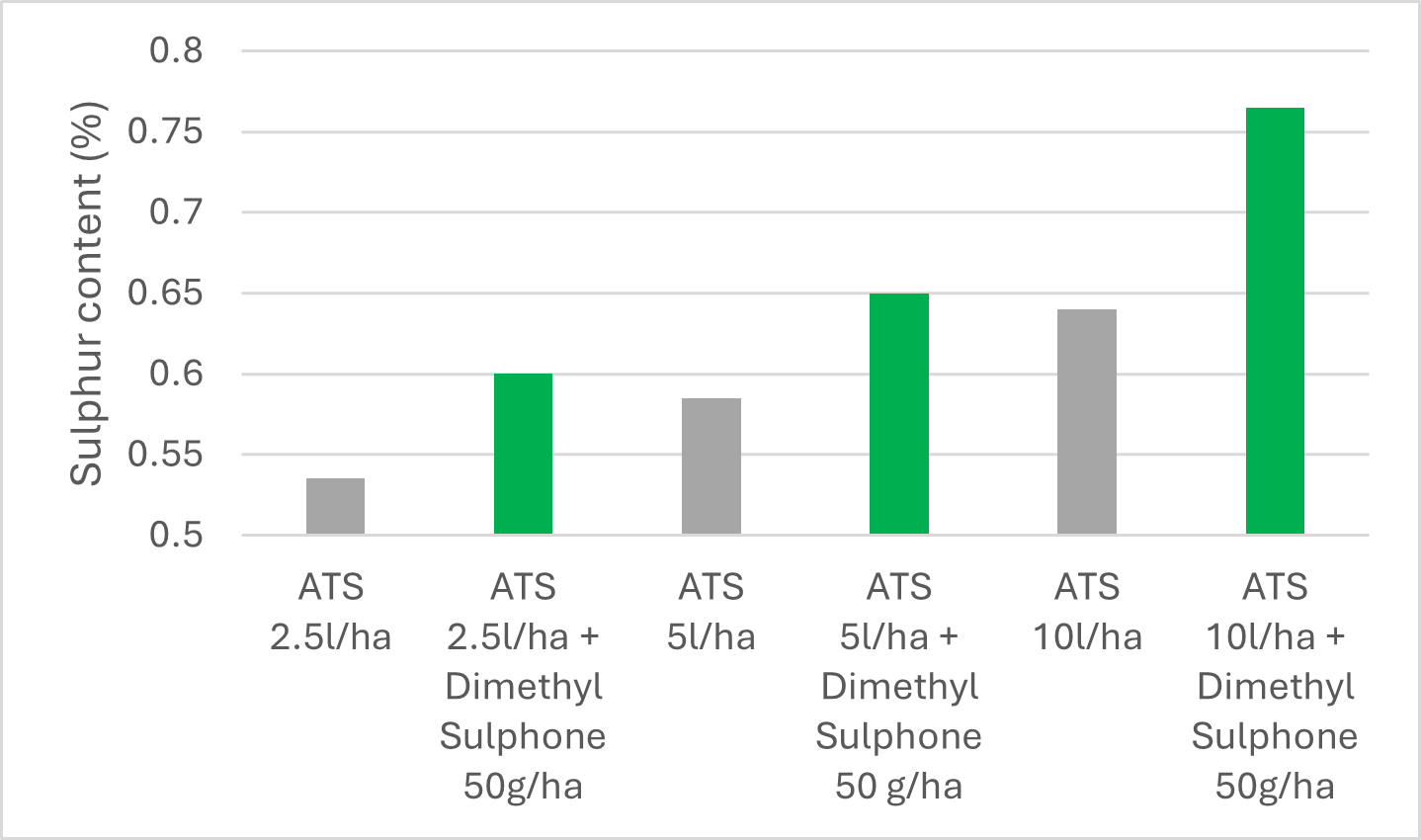
- Results after just 8 days showed a higher sulphur content in both crops when Dimethyl Sulphone was included — even when paired with lower ATS rates.
- Applications reduced the amount ATS needed by half compared to the amount needed when ATS was applied alone
- It enabled crops to absorb more sulphur from lower fertiliser doses than crops receiving higher doses of ATS alone.
Agronomic Benefits
Dimethyl Sulphone delivers multiple benefits across key arable crops, including:
- Enhanced Nutrient Uptake: Improves the transport and absorption of sulphur and other nutrients through the leaf cuticle and cell walls.
- Improved Nitrogen Use Efficiency: By supporting enzyme systems, it ensures that nitrogen is better assimilated and used for growth and protein formation.
- Yield and Protein Improvement: Crops treated with Dimethyl Sulphone exhibit higher protein content, better nutrient balance, and improved physiological performance — all of which contribute to higher, more marketable yields.
Application Recommendations
Crop Sulphur Requirement (SO₃/ha)
Winter Wheat: 25–40 kg
Oilseed Rape: 50–80 kg
Potatoes: 25 kg
Dimethyl Sulphone can be used in foliar applications, either independently or combined with ATS or other compatible mineral fertiliser inputs.
Conclusion
Dimethyl Sulphone is a powerful, research-backed biostimulant that maximises the efficiency of foliar nutrient applications, particularly sulphur. In doing so, it not only helps correct deficiencies but also improves yield quality, nitrogen efficiency, and crop marketability — with lower environmental impact.

