IntraCrop Visits the Institute of Experimental Botany in Prague
Recently, Emily Way and Nishka Kapoor from IntraCrop travelled to Prague to visit the Institute of Experimental Botany and meet Jaroslav Nisler, Head of Isotope Laboratory Organisation at the Institute of Experimental Botany. At IntraCrop, science is at the heart of what we do. We work closely with researchers to deepen our understanding of our technologies and turn scientific knowledge into practical solutions for growers.
Jaroslav Nisler played a leading role in the development of IntraCrop’s patented MTU® technology, working alongside the wider team that helped establish its mode of action and potential in crop production. Since the launch of MTU, IntraCrop has seen significant results across a variety of crops and growing conditions.
The visit provided an opportunity to discuss the latest scientific insights around MTU® and how our understanding of the molecule continues to develop.
MTU® is a single-molecule biostimulant technology that supports photosynthetic performance by enhancing Photosystem I activity and cyclic electron flow. Research has demonstrated its effects on green leaf retention, stress tolerance, root development and nutrient use efficiency.
The team also focused on IntraCrop’s newest patented single-molecule technology, TFU®.
TFU® has been developed through collaboration between IntraCrop, Palacký University and the Institute of Experimental Botany. It has a defined mode of action involving auxin and cytokinin pathways, with research focused on its ability to influence root and shoot development.
With glasshouse and field research already demonstrating promising effects on crop establishment, root development and yield, TFU® represents an important part of IntraCrop’s ongoing investment in new innovation.
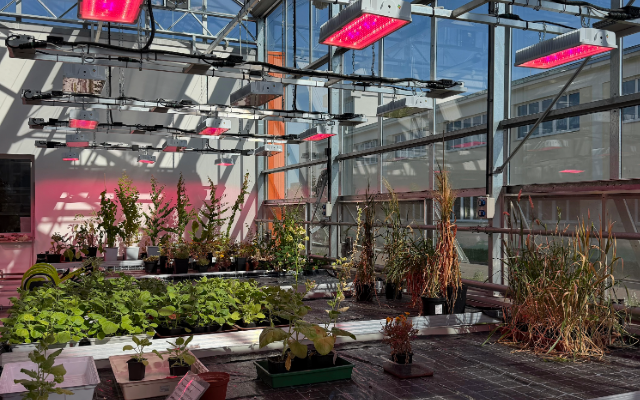
During the visit, the team were also able to see the Institute’s greenhouse facilities and view ongoing trial work involving both TFU® and MTU®. This allows the team to connect the underlying science with what is happening inside the plant and, ultimately, what may be observed in the field.
Our approach is built around collaboration with universities, research institutes and independent scientists, combined with extensive laboratory, glasshouse and field research. This allows us to investigate the science behind our molecules while keeping our focus on the practical challenges faced by growers.
14th October 2026
