Status® in Australia: early observations from the Boolah trials
Australia presents a challenging environment for crop production, with growers regularly managing variable weather conditions. As growers look for ways to make their inputs work harder, nutrient use efficiency is becoming an increasingly important consideration.
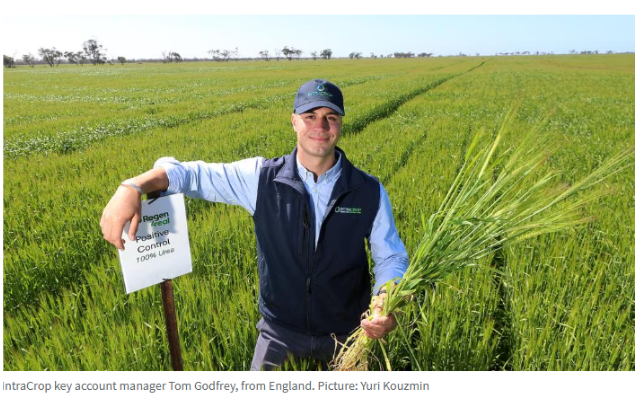
As part of IntraCrop’s ongoing work to evaluate Status® in Australian growing systems, our Key Account Manager, Tom Godfrey, recently visited two trial sites with Boolah at Wilkur, Victoria, and Pallamallawa, New South Wales. The visits provided an opportunity to see the trials first-hand, speak with growers and gain insight into how Status is performing under very different growing conditions.
Both trials were established with approximately 30% less of the total applied nitrogen, allowing Status to be evaluated within a reduced-nitrogen programme.
At Wilkur, high levels of rainfall have resulted in tall, lush crops. Under these favourable conditions, differences between the biological treatments were not immediately apparent. With the crop receiving good rainfall at key points in its development, the team is now looking forward to the yield and grain results to provide a clearer picture of how Status® has performed.
Conditions at Pallamallawa have been considerably more challenging. Rainfall has been sparse, with crops drilled into dry conditions and experiencing drought stress throughout their development. Here, the trial compared a full nitrogen rate with a reduced nitrogen rate supplemented with Status®. Early visual observations showed the reduced-N + Status® treatment performing positively, with the crop appearing to benefit from the application.
The trials also provided valuable insight into the priorities of Australian growers. While recent growing seasons have delivered strong yields in many areas, typical Australian conditions can be harsh, with water availability and heat placing significant pressure on crops.
Growers are looking at how they can make their existing inputs work more efficiently, with nitrogen use an important area of focus. Reducing nitrogen losses through processes such as volatilisation and leaching, while maintaining crop performance, is becoming an increasingly relevant challenge.
This is where Status® fits into the conversation. Combining MTU® and pidolic acid, Status® is designed to support photosynthetic activity and nitrogen assimilation, helping crops make better use of available resources.
Demonstrating the value of biostimulants remains important. Australian growers are cautious about biostimulants following experiences with products that have made strong claims without delivering consistent results. As a result, IntraCrop continues to prioritise local trial evidence and transparency to build grower confidence in Status®.
Tom found that growers recognised the differentiation of Status® were keen to learn more and explore where the technology could fit within their own farming systems.
Tom also noted that ease of integration is particularly important to Australian growers. Status® can be integrated into existing crop programmes without requiring a separate application pass, complex tank-mix instructions or specific storage conditions, making it a straightforward addition for growers looking to explore nutrient use efficiency strategies.
With two trial sites experiencing such contrasting conditions, the Boolah trials are providing a valuable opportunity to understand how Status® performs under different Australian conditions. The next step will be to see how the early field observations translate into yield and grain results.
As IntraCrop continues to build its Australian trial database, these results will help strengthen our understanding of where Status® can deliver value for Australian growers.
2nd October 2026

