
How does Status® protect wheat yields in extreme conditions?
Climate projections suggest an increase in the frequency of hotter, drier summers as well as warmer, wetter winters, making it difficult to assure good wheat yields. For growers this brings early crop nutrition and biostimulants into sharp focus as they look to protect autumn drilled cereals from yield limiting weather events.
2023 was a difficult year for growers, with a challenging autumn quickly followed by high winter rainfall During December crops experienced 48% more rainfall than average. Due to this extreme weather, growers are facing lazy rooting, lack of established root systems and leaching of nitrogen from the soil. In some cases, winter cereal drilling has not been able to take place at all.
This has created an environment for problems that may not become prevalent until later in the spring, by which time it may be too late to maximize yield or improve overall crop health. Currently, plants are still in early growth stages were rooting can be promoted and, if growers act quickly, mitigating action can be taken to build greater crop resilience
What is Status®?
Status® is a soluble liquid pure plant bio stimulant containing MTU (2g/L) and Pidolic acid (320 g/L), that increases nutrient use efficiency and combats abiotic stress.
In normal conditions, MTU delays age-related senescence of leaves improving chlorophyl retention, so plants have a higher photosynthetic activity. This increases Carbon assimilation resulting in faster crop growth and yield increases 5-12%. In stressed conditions, MTU enhances Cyclic Electron Flow around Photosystem I by 80% resulting in increased production of ATP providing energy for sugar production and growth during periods of abiotic stress. Crop yield is increased by 7-20%.
Pidolic Acid is a signaling compound at the heart of the nitrogen assimilation cycle, providing benefits in healthy and stressed conditions. In stressed conditions, a lack of Pidolic Acid signals a stress response in the plant. Therefore, respiration is prioritized, and growth slows down with the buildup of toxic ammonia. However, an application of Pidolic Acid increases amino acid synthesis and protein production, driving the nitrogen assimilation cycle for approximately 3-weeks.
How does Status® improve Nutrient Use Efficiency in wheat?
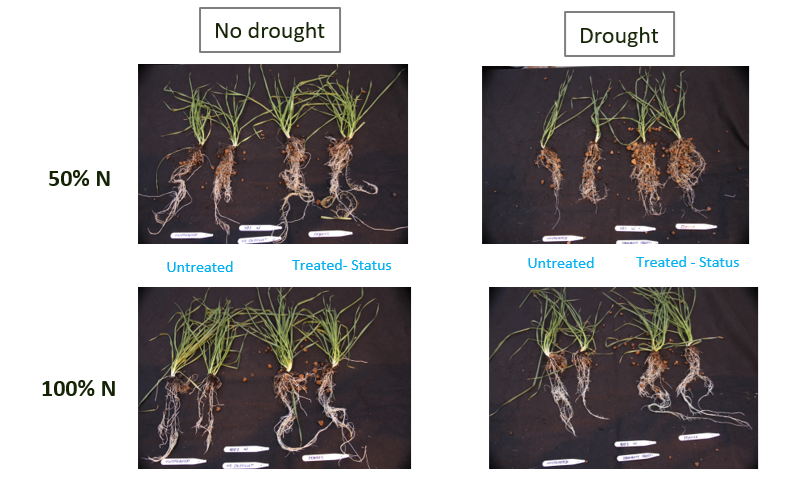
Plants must maintain a carbon-to-nitrogen ratio to perform essential cellular processes. During Photosynthesis, the plant fixes carbon from the atmosphere. Status® has a unique effect in boosting photosystem I and II, increasing photosynthetic pigment levels and driving photosynthesis. To maintain the ratio, it must absorb more nitrogen from the soil. Status® has been proven to boost root and shoot growth, better establishing the crop and increasing nutrient use efficiency. In spring 2023, ensuring good root growth is of particular importance, giving crops the best possible chance to reach nitrogen after it has been leached from the soil, and water should we now encounter a dry spring.
In the presence of 1 x 0.25l/ha application of Status®, yield increased by an average of 0.40 t/Ha over 54 trials across Northern Europe when compared to the control. The GS30-31 timing delivered the most consistent wheat yields. Overall, the average return on investment was £54/ha based on a single application.

How does Status® support wheat yields under a reduced Nitrogen regime?
SMN levels are currently low due to mineralisation and leaching of nitrogen. Status® has a positive impact in maintaining and increasing yield under a reduced nitrogen regime. Where nitrogen was reduced on average by 35 kg/ha across 5 European trials, the addition of a 1 x 0.25 l/ha application of Status® contributed to a 5% yield uplift relative to the reduced N control and equal to the Standard N regime.

When is the best time to use Status® for improved wheat yields?
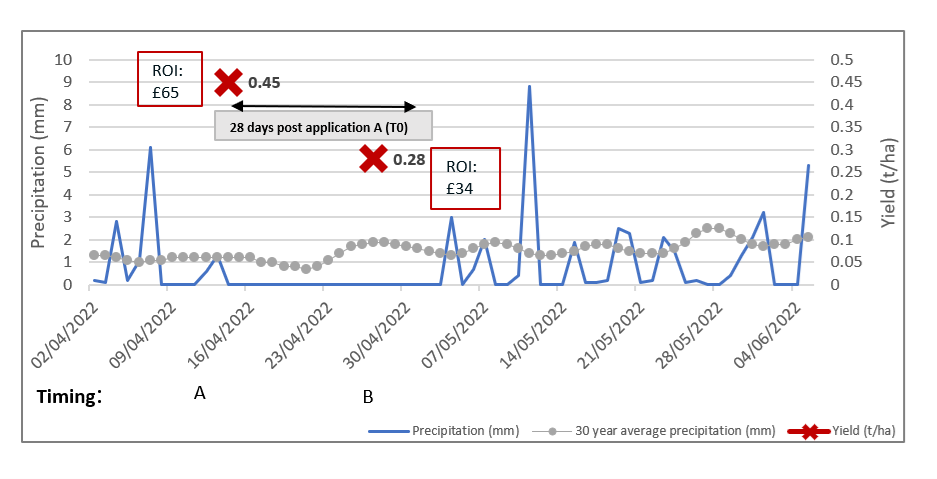
Analysis of weather data shows a positive response from Status® when applied pre peak stress. The main stress factor in Figure 4 can be attributed to a prolonged dry spell. Post application of Status® during mid-April (timing A, at GS29-30), precipitation levels were 0mm for a period prolonging 28 days, compared to an average rainfall total of 39.3mm. As a result, we saw a 0.45t/ha yield uplift. T0 is typically where we observe the most consistent yield response over the control because of the rooting benefits that Status® provides by continuing to produce ATP (energy) & sugars for growth during dry periods. Therefore, in this scenario, a 1 x 0.25l/ha application of Status®, delivered a return on investment of £65/ha.
T0 Decision Guide
| 1. Crop condition is... | 2. N-Inputs: The grower is planning to apply... | Decision | Rate | Why? |
|---|---|---|---|---|
| Healthy? | 100% N rate | Prosper Plus | 0.5 - 0.75 L/Ha | In non-stressed conditions phosphite delivers root & shoot growth benefits, to help improve NUE & crop resilience. |
| Reduction of N rate anticipated | Status | 0.2 - 0.25 L/Ha | Drive yield and quality when reducing N inputs, in trials Status at 60% N dose had significantly more chlorophyll & root mass than 100% N control. | |
| Showing signs of stress or stress is anticipated? | 100% N rate | Status | 0.25 L/Ha | Under drought stress Status delivered a 50% increase in root dry weight and a 15% increase in shoot weight relative to the untreated control. |
| Reduction of N rate anticipated | Status | 0.25 L/Ha | Increased concentration of chlorophyll & root growth during stress, as shown by 2022 NUE trial (Newcastle University) where using Status at T0 outperformed Gro Plan P by 1.5 t/ha under a 85%N regime. |

