
How does Status® improve crop safety?
In 2023, trials at the University of Debrecen in Hungary investigated the crop safety benefits of applying Status® in sequence with an Imazamox herbicide. Imazamox-treated crops are at risk of leaf yellowing, reduced growth and decreased photosynthetic performance. These trials studied the effects of applying Status® at 0.2L/ha to sunflower plants 4-, 7- and 10-days post herbicide application at 1.2L/ha (40g/L Imazamox). The trial suggests a 4-day interval between herbicide and the Status® application provides optimum results for crop safety.
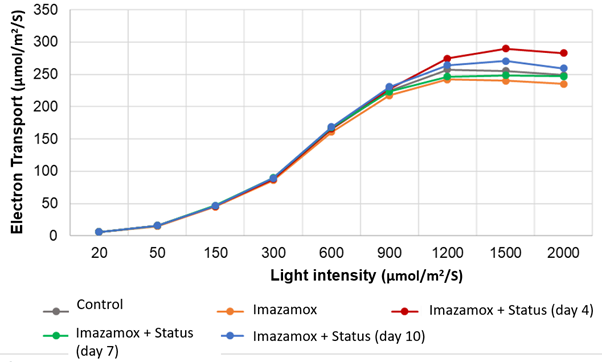
Status® contains our award-winning biostimulant technology MTU®. MTU® stablises cyclic electron flow in photosystem I within the chloroplast and keeps linear electron flow functioning, protecting the photosynthetic activity and efficiency of the photosystems. The trial investigated how photosynthetic intensity changed with increased light intensity under five treatments. The results showed that across all light intensities tested, the untreated control, followed by the Imazamox treatment alone, had the lowest photosynthetic intensities. However, when Status® was applied post-herbicide application, increases in photosynthetic intensity were observed, particularly with a Status® application 4 or 10 days later, as shown by the red and blue lines on the graph below.

Results from the study also demonstrated the effect of MTU® on electron transport. At high light intensities, the highest electron transport was recorded when Status® was applied 4 days after Imazamox application, with Imazamox application alone recording the lowest electron transport.
When an average is taken across the 6 replicates, herbicide applied alone reduced the root and shoot dry mass by 22% and 17% respectively, compared to the untreated control. However, when Status® was applied at 0.2l/ha 4 days after herbicide application, root and shoot dry mass increased by 9% and 28% respectively, compared to the control. This equated to a 21% increase in overall dry plant mass when Status® is sequenced with the herbicide compared to the untreated control, whilst an 18% decrease in overall dry plant mass was observed when the herbicide was applied alone.

The study quantified the differences in NDVI across the treatments. Whilst the Imazamox herbicide applied alone decreased the NDVI in comparison to the control, if Status® was applied 4 days post-herbicide application, NDVI was boosted above that of the control. The chlorophyll a and b content were measured for the different treatments. Herbicide followed by Status® 4 days after application saw a 25% increase in chlorophyll a, whereas herbicide applied alone reduced the chlorophyll a content by 12% compared to the control. An increase of 21% in chlorophyll b was also observed in the sunflower plants that received Status® 4 days post herbicide application and again, a decrease in chlorophyll b was observed when the herbicide was applied alone (31%). These results can be explained by the mode of action of MTU®. It uniquely increases the activity of photosystem I, increasing the chlorophyll content in the leaf, making the plant more sensitive to light.


Status® contains two biostimulant technologies; MTU® and pidolic acid. The effects of MTU® on photosynthesis and pidolic acid on nitrogen assimilation improve the plants resilience to stress, protecting the photosynthetic apparatus and increasing green leaf retention.
To summarise the main findings from the study:
- Applying Status® at 0.2 L/ha, 4 days after Imazamox herbicide application, provides optimum results for crop safety
- Increases in photosynthetic activity and electron transport were observed in the plants treated with Status® 4 days post herbicide application
- Status® 4 days post herbicide application increased root and shoot dry mass by 9% and 28%, respectively, compared to the untreated control
- Compared to the untreated control, 25% and 21% increases in chlorophyll a and b were observed in plants treated with Status® 4 days after Imazamox application
- Application of the Imazamox herbicide alone decreased all of the above parameters when compared to the untreated control
Find out more about Status® here.

