
How can I boost grain protein levels?
As the wheat harvest draws to a close, there has been a common theme across wheat quality, with growers across Europe experiencing lower than usual grain protein levels. In parts of Europe, this meant that water-soluble nitrogen applications could not be absorbed by the crops and this lack of nitrogen is likely to have hampered protein production. Additionally, high winter and spring rainfall in other parts of Europe has reduced availability of nitrogen due to leaching. Growers should consider incorporating Status® into their inputs regime to increase protein content, as demonstrated in a recent trial in Hungary.
The trial was conducted by an independent research organisation and investigated the effect of Status® on nitrogen use efficiency in spring wheat, and consequently the effect this had on final grain protein content. The protein content results can be seen below.
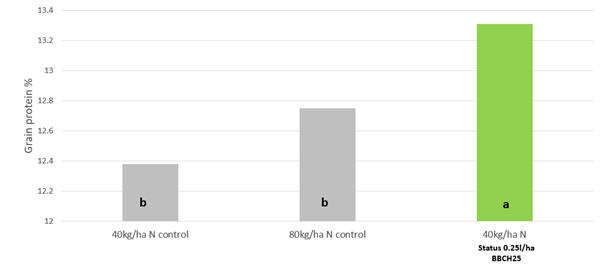
Under the full nitrogen regime (80kg/ha N), grain protein was recorded at 12.75% and this decreased to 12.38% when nitrogen was reduced by 50% (40kg/ha N). However, when a single application of Status® at 0.25l/ha was made at BBCH25 under reduced nitrogen conditions, grain protein was significantly increased to 13.31%. That is almost 1% higher grain protein than the 100% nitrogen control. In summary, this trial suggests a single, early application of Status® at 0.25l/ha is effective at boosting protein content, and this can be achieved at a reduced nitrogen rate.
Boosting protein is of significant financial importance to growers as wheat that meets milling specification (greater than 12% protein) can go for 284 euros per tonne*. However, if wheat goes for feed the price drops to 219 euros per tonne. In essence there is a 65 euro premium for milling wheat per tonne.
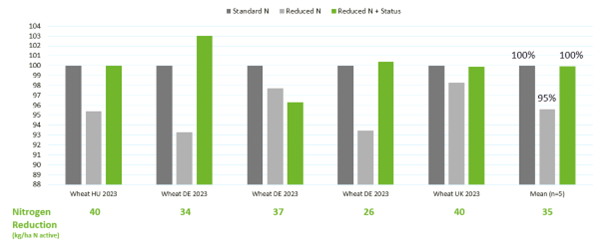
The graph below shows five winter wheat nitrogen use efficiency trials and demonstrates the benefit of applying Status® under reduced nitrogen conditions. On average across the five trials, when nitrogen is reduced by 35kg/ha, there is a 5% decrease in yield, however, when Status® is applied at 0.25l/ha under a reduced nitrogen regime, yield in maintained to the same level as the 100% nitrogen control.
MTU protects the photosynthetic apparatus and therefore enhances photosynthesis, meaning the plant is assimilating more carbon. To maintain the correct carbon-to-nitrogen ratio, the plant must take up more nitrogen which explains the increased nitrogen use efficiency. As nitrogen is a key nutrient required for protein production, maximising nitrogen use efficiency is key to increasing grain protein content. Pidolic acid is a signalling compound at the heart of the nitrogen assimilation cycle which aids the plant in converting applied nitrogen into amino acids and consequently proteins.
In summary, under a reduced nitrogen scenario, a single application at BBCH25 of Status® (0.25l/ha) can significantly boost wheat grain protein content higher than untreated plants in a full nitrogen regime. The synergistic effect of MTU® on photosynthesis and pidolic acid on nitrogen assimilation increase the nitrogen use efficiency of the crop, which enables the plant to take up and assimilate more nitrogen for protein production.
*Average grain price September 2024.

